Jinhua Hefa Science and Technology Co., Ltd.
Jinhua Hefa Science and Technology Co., Ltd.
Canister Purge Valve Supplier Checklist for Sampling and Approval
Created on 03.16
Finding the right partner for automotive parts is crucial. It's tough to choose someone who meets your high standards. Our guide helps you find quality and reliable partners.
We'll show you a simple checklist to review before you sign. This ensures your partner can meet your technical needs. It also checks if they follow safety laws.
canister purge valve supplier
Choosing a great team is more than just saving money. It's about trust and consistent results. We believe a detailed check today avoids big headaches later.
Let's look at the best way to test samples and get approval. This makes sure your project goes smoothly without unexpected delays or quality problems. Our aim is to make your approval process quick and effective.
Key Takeaways
- Verify the technical skills of the manufacturing team.
- Check all quality management certificates and standards.
- Review sample performance during the testing phase.
- Ensure full compliance with industry safety laws.
- Assess the ability to scale production for your needs.
- Build a foundation of trust for a long-term partnership.
1. Understanding the Importance of Supplier Vetting for Automotive Components
Supplier vetting is key to quality control in the auto industry. It's crucial for parts like canister purge valves. These parts must be reliable for good vehicle performance and to meet emissions rules.
Canister purge valves are vital in today's cars. They manage fuel vapor flow from the tank to the engine. This action cuts down on harmful emissions.
1.1 The Critical Role of Canister Purge Valves in Emissions Control
Canister purge valves are essential for the EVAP system in cars. They help keep fuel vapors from escaping into the air. This makes the air cleaner. A reliable purge valve manufacturer ensures these parts meet strict emissions standards.
The EVAP system works best when the canister purge valve is in good shape. If it fails, emissions go up, fuel efficiency drops, and there could be legal issues.
A modern automotive workshop setting featuring an array of canister purge valves displayed on a sleek metal workbench. In the foreground, focus on a detailed close-up of a purge valve with shiny chrome accents and intricate mechanical components, highlighting its engineering. The background shows blurred shelves filled with various automotive parts and tools, creating a professional ambiance. Natural daylight streams through large windows, casting soft shadows and enhancing the details of the valves. A technician in professional attire, inspecting the valves with a clipboard in hand, adds a human element, conveying diligence and professionalism. The mood is focused and industrious, emphasizing the importance of quality and supplier vetting for automotive components.
1.2 Consequences of Partnering with Unreliable Suppliers
Working with an automotive purge valve supplier that's not reliable can cause big problems. These include poor product quality, higher failure rates, and legal trouble. We've seen how bad parts can lead to expensive recalls and harm a company's image.
Also, unreliable suppliers can mess up the supply chain. This can cause delays and higher costs. It's vital to check suppliers well to avoid these issues.
1.3 How a Comprehensive Checklist Protects Your Business
A detailed checklist is a must for checking out suppliers. It makes sure the supplier meets quality, reliability, and legal standards. With such a checklist, we can avoid bad parts and keep the supply chain running smoothly.
Our checklist looks at the supplier's making abilities, quality control systems, and environmental rules. This careful check lets us work with suppliers who give us top-notch canister purge valves all the time.
2. Evaluating Your Canister Purge Valve Supplier's Technical Capabilities
Checking your canister purge valve supplier's tech skills is key to reliable car parts. Look at their making setup, quality control, and engineering help.
2.1 Manufacturing Infrastructure and Capacity
A good OEM canister purge valve supplier needs a strong making setup. This setup should handle your needs well.
2.1.1 Production Volume Capabilities
The supplier must make lots of parts without losing quality. They should have a history of delivering on time and in the right amount.
2.1.2 Advanced Manufacturing Technology
Using the latest making tech is important for quality valves. We look for suppliers with top-notch equipment for precise and consistent parts.
2.1.3 Facility Certifications and Cleanliness Standards
Suppliers must keep their places clean and have the right certifications. This is key in the car world, where clean parts work better.
2.2 Quality Management Systems and Certifications
A high quality purge valve supplier follows strict quality rules. This means:
2.2.1 ISO 9001 and IATF 16949 Compliance
Being ISO 9001 and IATF 16949 certified shows they have good quality systems. These standards are recognized worldwide.
2.2.2 Internal Quality Control Procedures
Good internal checks are key for reliable parts. We look for suppliers with strict checks and tests.
2.2.3 Continuous Improvement Programs
A reliable supplier always wants to get better. They do regular checks, listen to feedback, and work on making things better.
2.3 Engineering and Design Support
Technical know-how and design help are important. This means:
2.3.1 Technical Expertise and R&D Capabilities
Suppliers need strong tech skills and R&D to help with new products. This lets them offer special solutions and keep up with new needs.
2.3.2 Customization and OEM Support
Being able to customize and support OEMs is crucial. We value suppliers who work with us to create special solutions.
3. Comprehensive Sampling Procedures and Testing Protocols
Finding the right canister purge valve supplier is crucial. We need to know the detailed steps they take to check their products. This ensures the quality and performance of these parts.
Initial Sample Submission Requirements
The first step is to get samples that fit our needs. This is key to see if the supplier can meet our standards.
Sample Quantity and Specification Matching
Suppliers must provide us with sufficient samples that precisely match our requirements. This ensures we can conduct thorough testing without any complications.
Required Documentation and Test Reports
In addition to the samples, we require comprehensive reports and documentation. These should encompass details regarding materials, manufacturing processes, and any relevant certifications. For further information, please refer to the Guide to Air Sampling Analysis.
Performance Testing and Validation
Upon receipt of the samples, we conduct tests to evaluate their quality and performance.
Flow Rate and Pressure Testing
Testing the flow rate and pressure is crucial. It demonstrates the valve's performance under various conditions, aiding in the identification of any design or manufacturing defects.
Electrical Performance Verification
Verification of the electrical components is also essential. We ensure they function as intended.
Environmental and Durability Testing
These tests push the valves to their limits. They simulate real-world situations to see how long they last and how reliable they are.
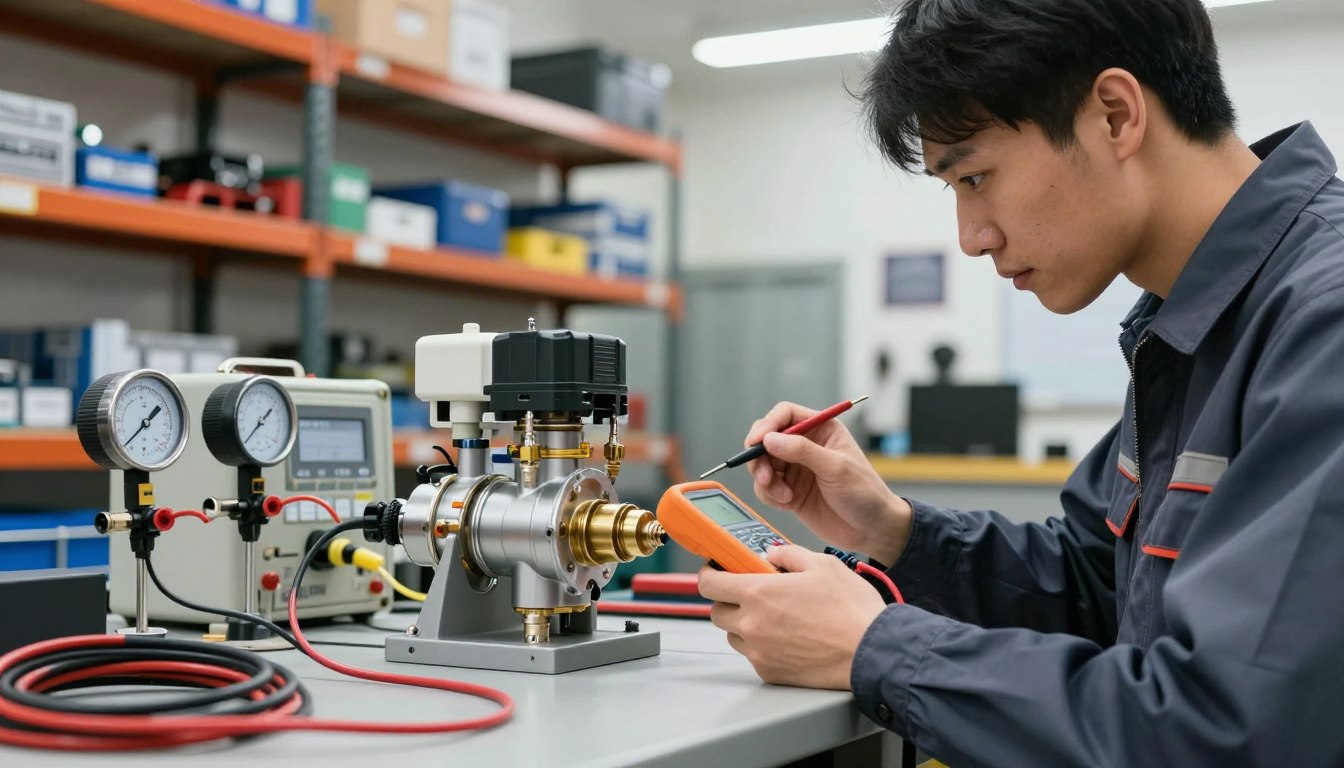
A detailed view of a canister purge valve testing setup in a well-lit automotive workshop. In the foreground, a technician in professional business attire is focused on using a multimeter to test the valve, demonstrating an engaged, analytical expression. The middle ground features the canister purge valve mounted securely on a workbench, with testing equipment, including a pressure gauge and hoses, neatly arranged nearby. In the background, shelves filled with automotive tools and spare parts create a realistic shop atmosphere, softly illuminated by overhead fluorescent lights. The image captures an atmosphere of professionalism and precision, highlighting the importance of thorough testing protocols in automotive maintenance. The angle should showcase both the technician's hands at work and the intricate details of the testing apparatus, ensuring a clear focus on the valve itself.
Comparative Analysis and Benchmarking
We compare the supplier's products to OEM specs and competitors. This helps us see how they stack up.
Testing Against OEM Specifications
We make sure the valves meet or beat OEM standards. This involves comparing their performance to the OEM's.
Competitor Product Comparison
We also compare the supplier's products to their competitors. This helps us see what makes their products stand out or fall short.
Testing Parameter | OEM Specification | Supplier's Product | Competitor's Product |
Flow Rate | 100 L/min | 105 L/min | 98 L/min |
Pressure Resistance | 10 bar | 12 bar | 9 bar |
Electrical Performance | 12V, 2A | 12V, 2.1A | 12V, 1.9A |
"The quality of canister purge valves is crucial for car systems. Suppliers must follow strict testing to ensure their products are up to standard."
— Industry Expert
By following these steps, we can find a reliable purge valve supplier. They will provide high-quality products that meet our needs.
4. Compliance Documentation and Supplier Qualification Standards
A top canister purge valve supplier must follow strict rules. They must show they meet these standards to ensure their parts work well.
Regulatory and Environmental Compliance
Following rules and protecting the environment is key for a supplier. They must stick to many emissions rules and regulations.
EPA and CARB Emissions Standards
The supplier needs to follow EPA and CARB emissions rules. These rules help make sure the canister purge valves control emissions right.
RoHS and REACH Compliance Verification
It's also important to follow RoHS and REACH. These rules make sure the parts don't have harmful substances and are safe.
Country-Specific Regulatory Requirements
Lastly, the supplier must follow local laws. This makes it easier to sell the parts in different countries.
Supply Chain Transparency and Traceability
Being open about the supply chain is crucial. This means keeping detailed records and tracking everything.
Component Source Documentation
Knowing where the parts come from is important. This includes knowing about the raw materials and parts in between.
Batch Tracking and Recall Procedures
Having good batch tracking and recall plans is key. This helps find and fix any problems quickly.
Third-Party Audit Results
Third-party audits check if the supplier follows the rules. These audits help make sure the supplier is doing a good job.
Business Continuity and Support Services
A good supplier has solid plans for keeping business going. They also offer great support when needed.
Warranty Terms and Coverage
Clear warranty terms protect the buyer. It's important to know what's covered and for how long.
Technical Support and Communication Channels
Good technical support and clear communication are essential. This helps solve problems fast and keeps everyone informed.
Lead Times and Inventory Management
Fast delivery and smart inventory management are important. They make sure parts arrive on time and are available when needed.
Compliance Aspect | Description | Importance |
EPA and CARB Emissions Standards | Adherence to emissions control specifications | High |
RoHS and REACH Compliance | Restriction of hazardous substances and chemical safety | High |
Supply Chain Transparency | Detailed documentation and tracking | High |
Warranty Terms and Coverage | Protection of buyer's interests | Medium |
Technical Support | Prompt issue resolution | High |
5. Conclusion
We've created a detailed checklist to find the best canister purge valve supplier. This ensures our car parts are top-notch, reliable, and follow all rules.
Looking closely at a supplier's skills, quality control, testing methods, and legal papers helps us pick the right one. This way, we can trust our canister purge valve supplier.
Being careful in our choice helps our business grow. It also makes our products better, helping the car industry be greener and more sustainable.
When picking a canister purge valve supplier, focus on quality, reliability, and following the rules. This keeps us ahead in the market.
FAQ
Why is it essential to vet a canister purge valve manufacturer thoroughly before partnering with them?
Thorough vetting is key to a successful supply chain. These components are vital for modern emissions control systems. Partnering with a quality supplier avoids high costs and penalties.
By checking a manufacturer's technical setup and history, we protect our brand. This ensures every vehicle meets environmental standards.
What specific certifications should we look for in an automotive purge valve supplier?
When evaluating a supplier, we focus on ISO 9001 and IATF 16949 certifications. These standards show the supplier's commitment to quality and improvement. A good supplier will be open about their certifications and cleanliness standards.
How can we verify the technical expertise of an OEM canister purge valve supplier?
Look at their R&D and history with major brands like Bosch and Delphi. A top supplier offers engineering support and customization. They should match OEM specifications and use advanced manufacturing technology.
What does the sampling and approval process look like with a renowned canister purge valve supplier?
The process starts with an initial sample submission. A renowned supplier will provide detailed test reports. These reports include flow rate, pressure, and electrical performance verification.
We compare these samples against ACDelco or OEM benchmarks. This ensures they meet or exceed standard performance.
How do purge valve distributors ensure environmental and regulatory compliance?
A reliable distributor must provide EPA and CARB emissions documentation. They should also show RoHS and REACH compliance. This ensures no hazardous substances are used.
We look for suppliers who offer full supply chain transparency. This includes batch tracking and third-party audit results. It ensures components are ethically and safely produced.
What business support services should we expect from a top canister purge valve supplier?
A top supplier offers more than just products. They provide business continuity with clear warranties and technical support. They also manage inventory and communicate efficiently.
This support keeps our operations smooth and our customers happy. A top supplier acts as an extension of our team.
Contact Us
We are committed to pursuing excellence in every endeavor and look forward to partnering with you for shared success.
Jinhua Hefa Science and Technology Co., Ltd.
Jinhua Hefa Science and Technology Co., Ltd.
Contact Person: Damon Wang
Tel: +86 17280953019
#1569,LinHu RD,JinXi Development Zone,JinHua,ZheJiang Province,PR.China.Post code:321075
About Us
About Us
Home
Home
Contact Us
Contact Us
Products
Products
News
News
Copyright ©️ 2025,Jinhua Hefa Science and Technology Co.,Ltd. All Rights Reserved.
Copyright ©️ 2025,Jinhua Hefa Science and Technology Co.,Ltd. All Rights Reserved.
Phone
Wechat