Jinhua Hefa Science and Technology Co., Ltd.
Jinhua Hefa Science and Technology Co., Ltd.
How to Shortlist a Vapor Canister Manufacturer for New Programs
Created on 03.16
Starting a new vehicle program is exciting for our team. Finding the right partner for automotive emissions solutions is key. A great vapor canister manufacturer helps us meet clean air rules and keep cars running smoothly.
We aim to make choosing a partner easy for you. The best collaborator does more than just supply parts. They help us achieve long-term success and high quality.
vapor canister manufacturer
By checking technical skills, we find the best fit for our project. Following these steps helps us stay ahead of new laws. Let’s explore the main factors for a smart choice for our next launch.
Key Takeaways
- Prioritize compliance with all environmental regulations for new fleets.
- Evaluate the technical expertise and history of potential partners.
- Focus on long-term performance and overall vehicle efficiency.
- Streamline the selection process to avoid costly project delays.
- Consider how a supplier adapts to ever-changing emission laws.
- Aim for high-quality production to ensure your program succeeds.
Define Your Program's Evaporative Emission Control Requirements
Understanding your evaporative emission control needs is key to a good partnership with a vapor canister maker. You need to know several important factors. These factors affect how the vapor canister works and is made.
Vehicle Platform and Fuel System Specifications
The vehicle's platform and fuel system are very important. They decide what kind of evaporative emission control technology you need. The design of the fuel tank, pump, and injectors affects the vapor canister's performance. It's crucial to know these details to make sure the vapor canister fits your vehicle's fuel system.
Target Emission Standards and Regulatory Compliance
Meeting emission standards and following regulations is vital. This helps reduce harm to the environment.
EPA Tier 3 and CARB LEV III Requirements
In the U.S., EPA Tier 3 and CARB LEV III rules are key. EPA Tier 3 aims to cut down on harmful vehicle emissions. CARB LEV III sets strict emission rules for California.
International Emission Regulations
Outside the U.S., rules like Euro 6 in Europe and CN 6 in China also matter. If you sell cars worldwide, you need to know these rules.
Production Volume Projections and Launch Timeline
Knowing how many cars you'll make and when is crucial. This helps pick a vapor canister maker that can meet your needs. Look at their production capacity, how fast they can make things, and if they can grow with you.
Evaluate Technical Capabilities in Vapor Recovery Systems
It's key to check a maker's tech skills in vapor recovery systems to meet emission rules. Look at their know-how in making and using fuel vapor recovery systems well.
Fuel Vapor Recovery Systems Design Expertise
A maker's design skills are crucial for creating vapor recovery systems that follow rules. They need to know about carbon canister technology and adsorption capacity. They also need to fit vapor capture technology smoothly.
Carbon Canister Technology and Adsorption Capacity
The success of a vapor canister depends on its carbon canister tech and adsorption power. Makers with top tech offer better performance and last longer.
Vapor Capture Technology Integration
It's important to integrate vapor capture tech well for a vapor recovery system's success. This needs a deep grasp of the fuel system and how it works with the vapor canister.
Engineering and Simulation Capabilities
A maker's engineering and simulation skills are key for improving vapor recovery systems. Using advanced simulation tools helps predict how the system will work under different situations.
Testing Facilities and Validation Processes
Having good testing facilities and validation steps is crucial to make sure vapor recovery systems meet standards. This includes:
Diurnal Breathing Loss Testing
Running Loss and Refueling Emission Tests
These tests check how the vapor canister works under different conditions.
A detailed illustration of an advanced vapor recovery system showcasing its intricate components. In the foreground, a close-up view of a sleek, modern vapor canister made of polished steel, with visible valves and pipes, demonstrating its technical sophistication. In the middle ground, an array of interconnected mechanisms and gauges, reflecting the engineering precision required in vapor recovery technology. The background features a clean industrial setting with subtle blue and green hues, highlighting the eco-friendliness of the system. Soft, even lighting emphasizes the metallic textures, while a shallow depth of field draws focus to the canister. The atmosphere should convey innovation and reliability, suggesting a cutting-edge solution in vapor management.
Testing Type | Purpose | Benefits |
Diurnal Breathing Loss Testing | Evaluate vapor canister performance under varying temperatures | Ensures compliance with emission standards |
Running Loss and Refueling Emission Tests | Assess vapor canister performance during vehicle operation and refueling | Validates system effectiveness in real-world conditions |
Assess Quality Systems and Industry Certifications
Checking a vapor canister maker's quality systems and certifications is key. It shows if they can meet your needs. This ensures their products are top-notch and follow the rules.
OEM Evaporative Emission Control Certification Status
The OEM evaporative emission control certification is very important. It shows if a maker can make vapor canisters that follow the rules. We must check if they have the right certifications from places like CARB or EPA.
Quality Management Standards
Following quality management standards is crucial. It makes sure vapor canisters are reliable and consistent. We will look at if the maker follows these standards.
IATF 16949 Compliance
IATF 16949 is a big deal for car quality management. If a maker follows this, it means they have a strong quality system.
ISO 14001 Environmental Management
ISO 14001 shows a maker cares about the environment. This is important for vapor canister makers. Their products help cut down on emissions.
Product Warranty and Field Performance History
Looking at a maker's warranty and how their products do in real life is helpful. A good warranty and strong field performance show they trust their products.
Certification | Description | Importance |
IATF 16949 | Automotive quality management standard | Ensures robust quality management |
ISO 14001 | Environmental management standard | Demonstrates commitment to sustainability |
OEM Evaporative Emission Control Certification | Certification for evaporative emission control | Ensures compliance with regulatory standards |
Review the Vapor Canister Manufacturer's Production and Supply Chain Strength
Checking a vapor canister manufacturer's production and supply chain is key. It helps see if they can meet your needs. This check is important to know if they can handle your production and keep quality high.
Manufacturing Capacity and Geographic Footprint
The size of a vapor canister manufacturer's production and where they are located matters a lot. A big global presence and enough production can handle demand changes well.
North American Production Facilities
North American production facilities help cut down on lead times and improve logistics. This makes supply chain management more flexible and quick, which is important in the car industry.
Scalability for Program Growth
It's important to see if the manufacturer can grow with your program. Look at if they can make more, hire more people, and keep up with new rules.
Supply Chain Management and Raw Material Sourcing
Good supply chain management and raw material sourcing are key for quality and reliability. A well-run supply chain can avoid problems with materials and quality.
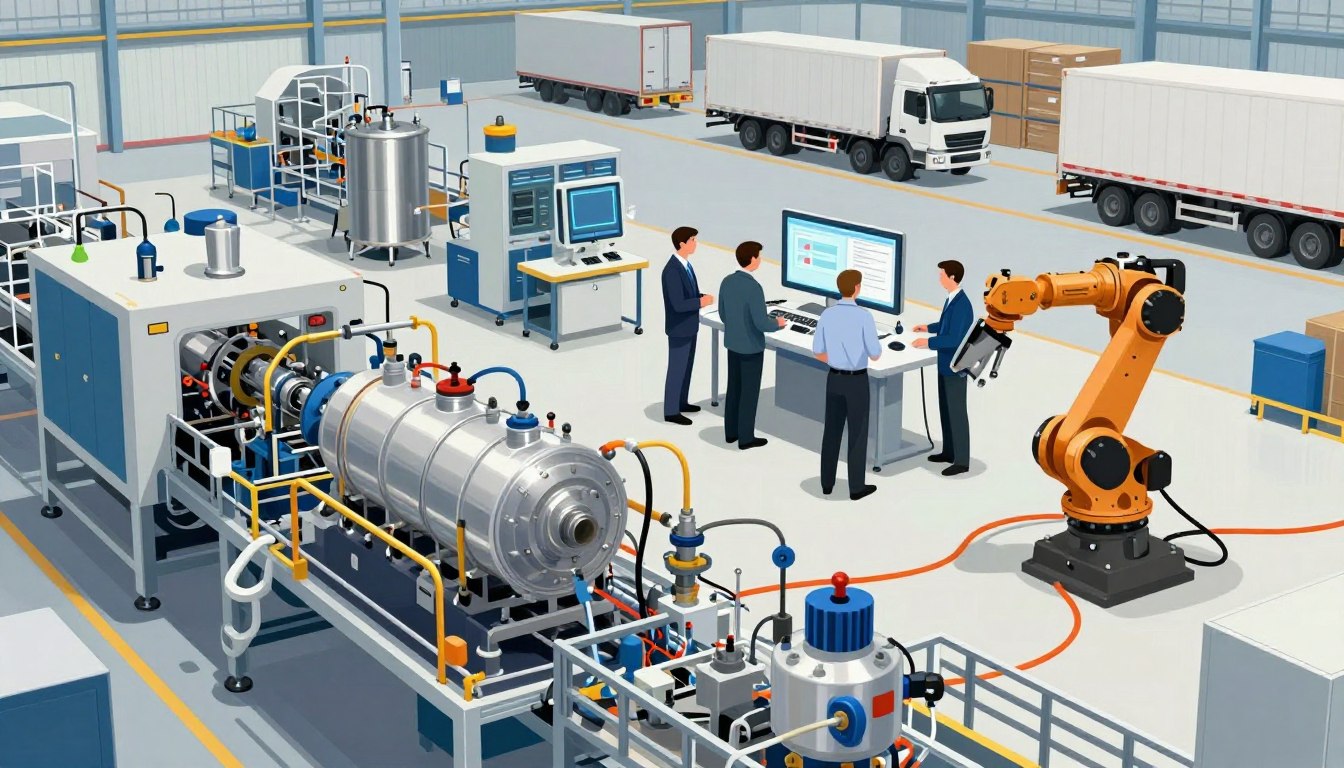
A detailed, technical illustration of a vapor canister manufacturing supply chain. In the foreground, showcase a high-tech manufacturing facility, with machinery and production lines visible. In the middle ground, depict workers in professional business attire interacting with advanced robotics and quality control systems, emphasizing collaboration and efficiency. In the background, include a logistics area with trucks and warehouses, symbolizing distribution and storage. The lighting should be bright and industrial, creating a clean and focused atmosphere. Use a wide-angle lens perspective to capture the expansive scale of the facility, conveying the complexity and robustness of the production and supply chain process. The overall mood is one of innovation and professionalism, highlighting the importance of a strong supply chain.
Automotive Emissions Solutions Portfolio Breadth
A vapor canister manufacturer with a wide range of automotive emissions solutions can offer more support. They can provide different products and technologies to cut emissions and boost fuel efficiency.
Experience with Vehicle Emissions Management Programs
The manufacturer's experience with vehicle emissions management programs is also important. Their knowledge ensures your program meets emissions standards and follows rules.
Analyze Cost Competitiveness and Partnership Value
When choosing a vapor recovery canister supplier, it's key to look at more than just the price. We must consider the total cost and the value they add to our program.
Total Cost Analysis Beyond Piece Price
Looking at the total cost means more than just the initial price. We also need to think about tooling, development, logistics, and inventory management costs.
Tooling and Development Costs
Tooling and development costs can really add up. It's important to see if the supplier can handle these costs well.
Logistics and Inventory Management
Good logistics and inventory management help keep costs down and ensure timely delivery. A reliable supplier should have a solid plan for these areas.
Value Engineering and Cost Reduction Initiatives
A supplier's focus on value engineering and cost savings is crucial. We look for those who actively work to improve their products and processes.
Technical Support and Collaborative Development Approach
Having a supplier that works with us and offers strong technical support is key. We want someone who can help solve problems and provide ongoing support.
Here is a comparison of key factors to consider when evaluating a vapor canister manufacturer:
Factor | Importance | Evaluation Criteria |
Total Cost Analysis | High | Piece price, tooling and development costs, logistics and inventory management |
Value Engineering | Medium | Design optimization, cost reduction initiatives |
Technical Support | High | Collaborative development approach, ongoing technical support |
Effective Vapor Canister Manufacturers for New Programs
Finding the right vapor canister manufacturer is key for new programs. Look at their technical skills, quality systems, and production power. A good partner should have top-notch vapor containment and capture tech.
There's ongoing research into direct disposal methods. Tests show that using Sn-Bi eutectic can fill gaps well. This is good news for direct disposal research.
When picking a vapor canister maker, think about cost and scalability. The right partner ensures your vehicle runs well and meets rules. We've outlined what to consider for a successful partnership.
FAQ
Why is selecting the right vapor canister manufacturer so critical for our new vehicle programs?
Choosing the right vapor canister manufacturer is more than just finding a part. It ensures our vehicles meet strict environmental standards. This helps avoid costly recalls and keeps our vehicles running smoothly.
By picking an experienced partner, we guarantee our vehicles meet top standards. This is true from the first prototype to the final product.
How do EPA Tier 3 and CARB LEV III standards influence our choice of a vapor recovery canister supplier?
Meeting EPA Tier 3 and CARB LEV III standards is key. We need a supplier who knows these rules well. These standards require advanced technology to control emissions better.
We look for partners who keep up with these changes. This ensures our vehicles meet emissions standards everywhere we sell them.
What technical capabilities should we prioritize in fuel vapor recovery systems?
Technical know-how in fuel vapor recovery is essential. We need expertise in carbon canister tech, adsorption, and vapor capture. It's important to find a supplier with strong engineering tools and testing facilities.
They should be able to test emissions in-house. This ensures our solutions are effective and last long.
What quality certifications should a manufacturer hold to ensure program success?
We need our partners to have specific certifications. IATF 16949 for quality management and ISO 14001 for environmental standards are must-haves. These certifications show us our supplier can deliver quality and reliable performance.
How does a manufacturer’s geographic footprint affect our vehicle emissions management?
A manufacturer's location affects our launch times and costs. We prefer a strong North American presence for better communication and logistics. They should also be able to grow with us as we produce more vehicles.
A diverse range of emissions solutions and a proven track record help streamline our supply chain. This reduces the risk of problems.
Why should we look at the total cost of ownership rather than just the piece price?
The total cost of ownership is more important than just the price of a part. We consider tooling, development, logistics, and inventory costs. A partner that offers cost-saving ideas can save us a lot of money over time.
Good technical support and collaboration can also lead to more efficient designs. This means we can get our products to market faster, saving us even more money.
Contact Us
We are committed to pursuing excellence in every endeavor and look forward to partnering with you for shared success.
Jinhua Hefa Science and Technology Co., Ltd.
Jinhua Hefa Science and Technology Co., Ltd.
Contact Person: Damon Wang
Tel: +86 17280953019
#1569,LinHu RD,JinXi Development Zone,JinHua,ZheJiang Province,PR.China.Post code:321075
About Us
About Us
Home
Home
Contact Us
Contact Us
Products
Products
News
News
Copyright ©️ 2025,Jinhua Hefa Science and Technology Co.,Ltd. All Rights Reserved.
Copyright ©️ 2025,Jinhua Hefa Science and Technology Co.,Ltd. All Rights Reserved.
Phone
Wechat